
Not all consent software is built the same. Generic consent management tools work well for simple websites and apps, but high-volume regulated businesses — telecom, banking, fintech, healthcare — run into their limits fast. Here’s exactly where the gap shows up, and what to look for instead.
💡 Quick take: If your consent tool can’t handle SMS opt-ins, offline or unregistered users, or core system integration, it wasn’t built for enterprise scale. That gap becomes a compliance risk fast.
🔍 Why Generic Consent Management Tools Fall Short
Most consent management tools on the market were designed for a specific use case: website cookie banners and app permission screens. They handle that job well. However, businesses in telecom, banking, fintech, and healthcare deal with a fundamentally different environment — millions of customer records, multiple communication channels, and consent that needs to sync across billing, CRM, and campaign systems in real time.
As a result, generic tools often break down exactly where these industries need them most: at scale, across channels, and under regulatory scrutiny.
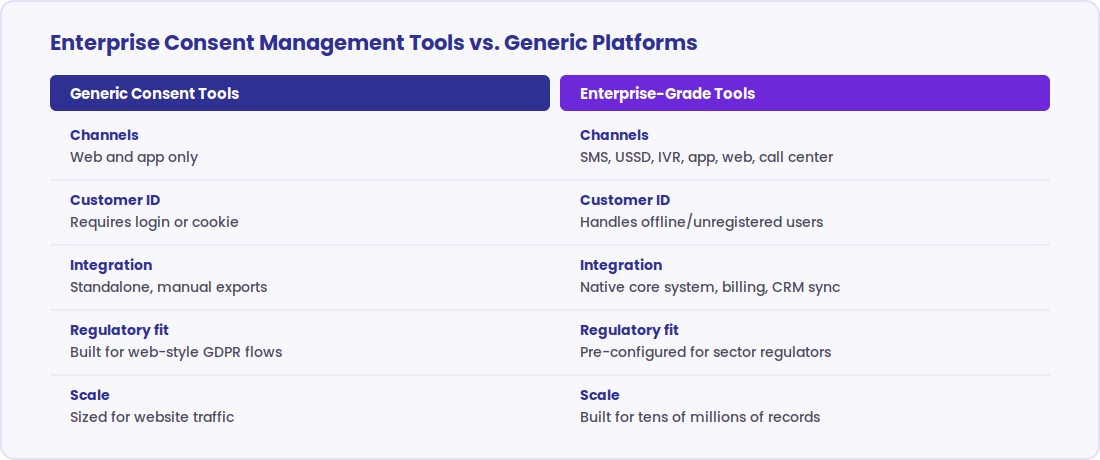
⚖️ Enterprise Consent Management Tools vs. Generic Platforms
🚩 Warning Signs Your Current Tool Isn’t Built for Scale
A few patterns tend to show up quickly. Your team manually exports consent data to update other systems. Offline or unregistered customers fall outside your consent records entirely. SMS or call center opt-outs don’t sync automatically with your marketing platform. Or your last compliance audit took weeks instead of minutes, because there was no single, exportable record to hand over.
Any one of these signals a structural mismatch, not a minor inconvenience. Industry bodies like GSMA increasingly expect regulated businesses to produce clean, auditable consent trails on demand, and generic tools rarely make that possible without heavy manual work.
✅ What to Look for in an Enterprise-Grade Solution
A genuine enterprise-grade platform should capture consent across every customer touchpoint automatically, enforce preferences in real time across billing and CRM, and generate audit-ready reports without manual assembly. Consentry was built around exactly this checklist — originally for telecom, and increasingly relevant to any high-volume regulated business. For the telecom-specific picture, see our guide on what a Telecom Consent Management System actually does.
Still relying on a generic consent tool at enterprise scale? See what purpose-built actually looks like.
❓ Frequently Asked Questions
Comparing Consent Management Tools
What’s the main difference between generic and enterprise-grade consent management tools?
Generic tools cover web and app consent only. Enterprise-grade tools additionally handle SMS, USSD, and call center channels, offline or unregistered customers, and direct integration with core business systems like billing and CRM.
Can businesses use a generic consent tool and add advanced features later?
In theory, yes, through heavy customization. In practice, this usually costs more and takes longer than deploying a platform built for scale from the start, since core architecture decisions are hard to retrofit.
Do offline or unregistered customers need consent management too?
Yes. Prepaid telecom subscribers, walk-in banking clients, and similar unregistered customers still receive marketing messages, data collection, and services, all of which require documented consent. Generic tools built around logged-in web users often miss this segment entirely.
Making the Switch
How do I know if my current consent tool is a poor fit for my business?
Common warning signs include manual data exports between systems, missing records for offline or unregistered customers, SMS or call center opt-outs that don’t sync automatically, and audits that take weeks to prepare instead of minutes.
Is switching to an enterprise-grade platform disruptive for existing operations?
A well-designed migration typically imports existing consent records rather than starting from zero. Businesses generally run both systems briefly in parallel, then cut over once data integrity is confirmed.