
PDPL data subject rights give every customer in Saudi Arabia a say over their own personal data. For example, they can ask what you hold, get a copy, fix it, or ask you to destroy it. However, each request starts a clock. So the real question is simple: can your team find the data and reply on time?
💡 Quick take: The PDPL gives customers five core rights. Most businesses can meet them on paper. The hard part is answering fast when the data sits in many systems.
📜 The Five PDPL Data Subject Rights
To begin with, Article 4 of Saudi Arabia’s Personal Data Protection Law lists the rights. The Saudi Data and AI Authority (SDAIA) oversees the law.
1. Be informed
Know the legal basis and the purpose for collecting their data.
2. Access
See the personal data you hold about them.
3. Get a copy
Receive their data in a clear, readable format.
4. Correct
Ask you to fix, complete or update their data.
5. Destroy
Ask you to destroy data that is no longer needed.
On top of this, Article 5 lets people withdraw consent at any time. In practice, this works like a sixth right. Once they withdraw, the processing based on that consent must stop.
⏱️ How Fast You Must Respond
The law leaves deadlines to its Implementing Regulation. Under that regulation, a business has 30 days to answer a request. It can extend that period in some cases, but it must tell the person.
Meanwhile, SDAIA has put draft changes to the regulation out for public comment. One proposal would treat an unanswered request as rejected once the deadline passes. The customer could then complain to SDAIA. These changes are not final yet. Still, they show where the regulator is heading.
🔄 Handling PDPL Data Subject Rights Requests Step by Step
A good process turns each request into a routine task. Here is the flow most teams need.
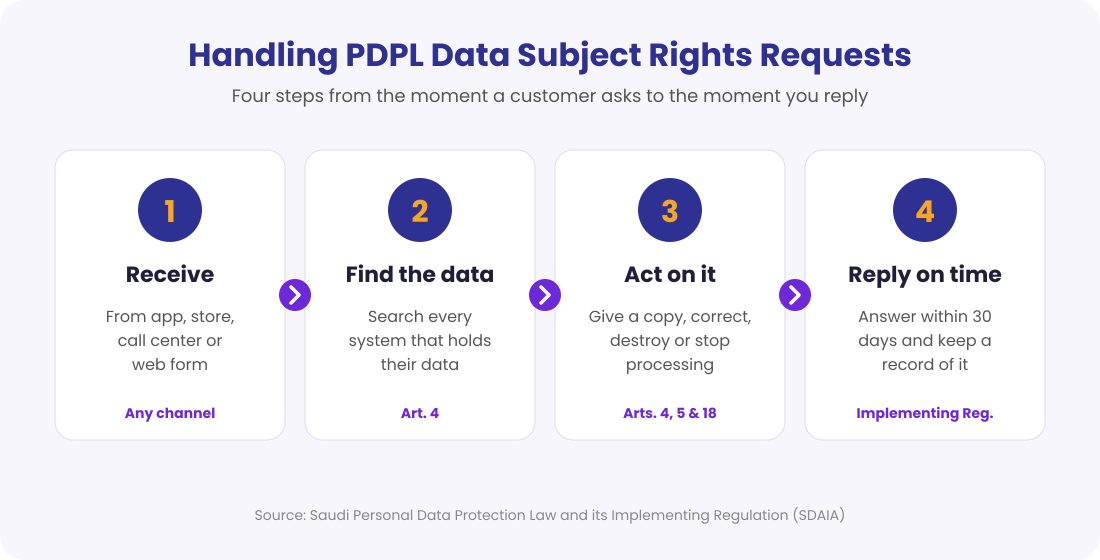
First, accept requests on any channel the customer uses. Next, find every system that holds their data. Then act on the request, whether that means a copy, a fix or deletion. Finally, reply within the deadline. It also helps to log each step, so you can show the regulator what you did.
📡 Why PDPL Data Subject Rights Are Harder in Telecom
Take a typical operator. One subscriber’s data lives in billing, CRM, the mobile app, retail systems and marketing tools. As a result, a single access request means searching all of them. Telecom operators also answer to the Communications, Space and Technology Commission (CST), so subscriber data gets close attention.
| Common gap | What fixes it |
|---|---|
| Requests arrive by email, store and call center, with no single queue | One intake point with a tracked deadline |
| Data spread across many systems | A clear map of where each data type lives |
| Consent withdrawn in the app but not in marketing tools | Real-time consent sync across every system |
| No proof of what was done or when | A timestamped log for every request |
🛡️ Managing PDPL Data Subject Rights with Consentry
TeC Consentry gives subscribers a self-service portal. There, they can view their consents and withdraw them at any time. Then every change syncs to your other systems in real time. In addition, each action lands in a tamper-evident audit log, so evidence is ready when SDAIA or CST asks.
For the consent side of the law, read our guide to PDPL consent management in Saudi Arabia. To see the wider benefit, read how consent management reduces regulatory risk.
Can you answer every rights request in 30 days?
See how Consentry keeps consent and request records audit-ready.
TeC Platform Editorial Team
Digital Enablement & Telecom Insights
TeC by Evamp & Saanga is a digital engagement platform trusted by telecom and fintech operators to power SuperApps, self-care, consent management, and dealer ecosystems worldwide.
Posted by: Yusra Naeem
❓ Frequently Asked Questions
Understanding PDPL Data Subject Rights
What rights does the PDPL give customers?
Customers can learn why you collect their data. They can also access it, get a copy, correct it, or ask you to destroy it. They can also withdraw consent at any time.
How long do I have to answer a request?
The Implementing Regulation gives 30 days. You can extend it in some cases, but you must tell the customer.
Who enforces these rights?
SDAIA oversees the PDPL. Customers can complain to it if a business does not respect their rights.
PDPL Data Subject Rights in Practice
What happens when a customer withdraws consent?
You must stop the processing based on that consent. Past processing stays lawful. So make sure the change reaches every system, including marketing tools.
Should we keep a record of each request?
Yes, it is good practice. A timestamped record shows the request, your action and the date. That is your proof if a regulator checks.
Can one platform handle Saudi Arabia and other markets?
Yes, if it supports market-specific rules. As a result, a group can manage the Saudi PDPL, UAE, Kenya and Nigeria in one system.