
Data protection enforcement is accelerating across the Middle East and Africa. For telecom operators, this makes a dedicated Consent Management Platform less of a future consideration and more of a current operating requirement. Here’s what’s driving that shift, and what operators should look for in 2026.
💡 Quick take: Regulators across Saudi Arabia, the UAE, Kenya, and Nigeria have all issued active enforcement decisions in 2025-2026. Consent management has moved from best practice to proven legal exposure.
📜 Why Regulatory Pressure Is Rising Now
Telecom operators handle some of the largest and most sensitive subscriber datasets of any industry — call records, location data, billing information, and messaging preferences. As a result, regulators increasingly treat telecom as a priority enforcement sector, not an afterthought.
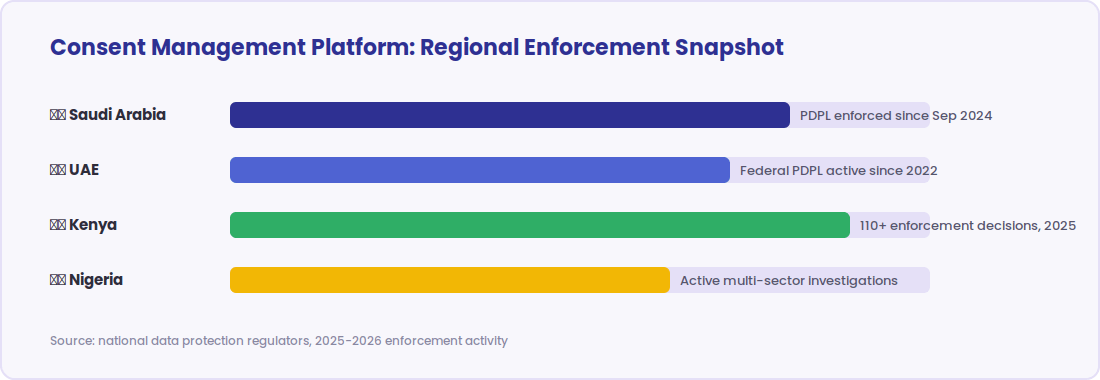
This shift is visible across multiple markets at once. Saudi Arabia’s PDPL grace period ended in September 2024, and its regulator has since confirmed dozens of violation decisions. Kenya’s data protection authority issued more than 110 enforcement decisions in 2025 alone. Nigeria’s regulator is actively investigating multiple sectors in 2026, and courts have already fined institutions for consent failures. The GSMA has tracked this broader shift toward stronger data governance across emerging telecom markets.
🌍 Consent Management Platform Demand by Region
⚙️ What a Modern Consent Management Platform Needs to Do
Meeting this moment takes more than a basic opt-in checkbox. A genuine Consent Management Platform for telecom operators should cover several things at once. It needs to capture consent across every channel — SMS, USSD, app, web, and call center. It needs to maintain an auditable, timestamped record regulators can review on demand. And it needs to integrate directly with CRM, billing, and campaign systems, so consent status is enforced automatically rather than checked manually.
Generic, website-oriented consent tools rarely meet this bar. They typically can’t handle prepaid subscriber verification or SMS-based consent flows, which are core to telecom operations across these markets.
🚀 Getting Ahead Instead of Catching Up
Many operators built quick, manual compliance workarounds to meet earlier deadlines like Saudi Arabia’s 2024 PDPL cutoff. However, those stopgap systems rarely hold up under ongoing regulatory scrutiny. As enforcement expands into new markets and matures in existing ones, operators need infrastructure that scales with regulation, not a one-time fix built for a single deadline.
This is precisely where Consentry fits. It is a Telecom Consent Management Platform built specifically for operator-scale complexity, across multiple markets and regulatory regimes at once. For a deeper look at the core mechanics, see our guide on what a Telecom Consent Management System actually does.
Ready for a Consent Management Platform built for regional telecom complexity?
❓ Frequently Asked Questions
Choosing a Consent Management Platform
Why do telecom operators need a dedicated Consent Management Platform?
Telecom operators manage subscriber data at a scale and complexity that generic consent tools weren’t built for. A dedicated platform handles SMS and USSD consent flows, prepaid subscriber verification, and direct integration with billing and CRM systems.
Which countries currently have active data protection enforcement for telecom?
Saudi Arabia, the UAE, Kenya, and Nigeria all have active enforcement activity as of 2026, each with a telecom-specific regulatory layer on top of general data protection law.
Can one platform handle consent management across multiple countries?
Yes, provided the platform supports configurable, market-specific consent workflows. This lets a single operator group manage compliance consistently across every market it operates in, rather than maintaining separate systems per country.
Consent Management Platform Compliance and Risk
Are older, manual consent processes still legally acceptable?
In most active markets, no. Regulators increasingly expect operators to demonstrate an auditable, timestamped consent trail, not just a one-time signed form. Manual or spreadsheet-based processes rarely satisfy this standard at scale.
What happens if an operator’s consent records don’t hold up under audit?
Regulators can issue fines, and enforcement decisions in several markets already show real financial penalties for consent failures. Beyond fines, operators risk reputational damage and reduced subscriber trust.